
TL;DR:
- Buterin proposed replacing Ethereum’s hexary state tree with a binary structure under EIP-7864, increasing efficiency by 100x.
- This change would reduce Merkle branch length by four times and could save more than 10,000 gas per transaction in frequently used dapps.
- Longer term, Buterin proposes replacing the EVM with a RISC-V virtual machine to eliminate bottlenecks in ZK proof generation.
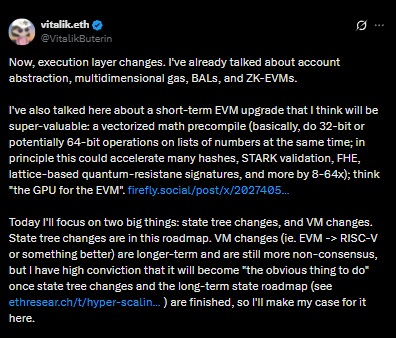
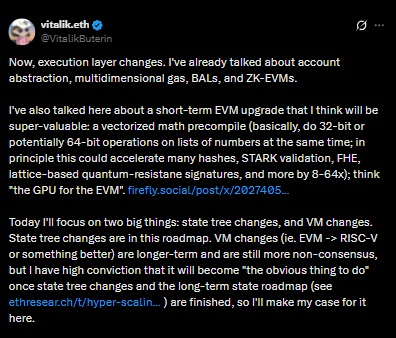
Vitalik Buterin published an extensive technical proposal identifying two structural changes he considers essential for the future of Ethereum: a modification to the state tree and a replacement of its virtual machine. Both target the same underlying problem: the current architecture is not optimized for an environment where the efficient generation of ZK proofs is a central priority.
The first of the changes is already in development. EIP-7864, being worked on by Guillaume Ballet and other contributors, proposes migrating from the hexary Merkle Patricia Tree based on keccak to a binary tree with a more efficient hash function. The technical difference is significant: Merkle branches are reduced by four times, which lowers client-side verification costs and reduces the bandwidth required to use tools like Helios and PIR by the same factor.
Added to this is the improvement of the hash function: blake3 could deliver an additional 3x over keccak, while a Poseidon variant would reach 100x, although Buterin warns that the latter requires additional security work before it is ready for production.
Buterin Wants to Change the Foundations of Ethereum
The binary design also introduces a page-based storage scheme that groups between 64 and 256 contiguous slots. The block header and the first kilobytes of code and storage share the same page, allowing contracts that read their first storage slots to benefit from batch efficiency rather than paying individual access costs. Buterin estimates this could save more than 10,000 gas per transaction for dapps already operating under that pattern, which represent a considerable portion of active deployed contracts.
The second change is more speculative. Buterin proposes replacing the EVM with RISC-V, the architecture currently used by ZK provers. If the proving infrastructure is already written in RISC-V, a native virtual machine in that standard eliminates the limitation rather than managing it through accumulated precompilations. A RISC-V interpreter requires just a few hundred lines of code, compared to the growing complexity of the EVM.

The roadmap Buterin outlines has three stages: first, RISC-V only for precompilations; then, opening it up for user-deployed contracts; finally, the EVM is retired and reimplemented as a smart contract written in the new VM. Full backward compatibility is preserved for existing contracts, with adjustments to gas costs that Buterin considers minor relative to the ongoing scalability work. Together, the tree and the VM account for more than 80% of the bottleneck in efficient proof generation, according to Vitalik himself.